 by
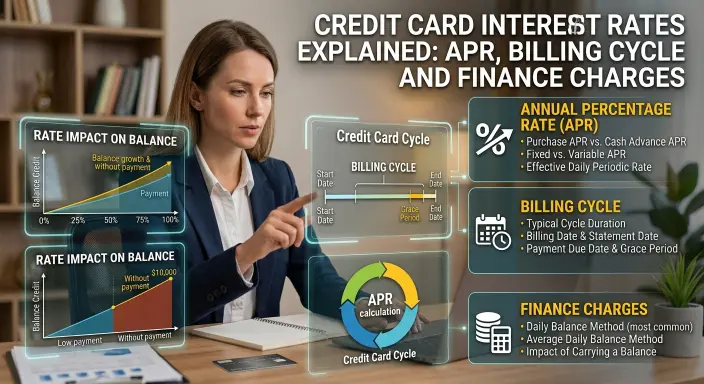
by Credit card interest rates can be confusing, especially if you are using a credit card for the first time. Terms such as APR, billing cycle, finance charge, statement balance, and grace period often appear on credit card statements and agreements. Understanding these terms can help you know what you may pay when you carry a balance.
A credit card can be convenient for everyday purchases, but interest can make borrowing more expensive when balances are not paid according to the account terms.
In this guide, FinanceTrack America explains credit card interest rates, APR, billing cycles, finance charges, grace periods, and other important concepts in simple language.
What Is a Credit Card Interest Rate?
A credit card interest rate is the rate used to determine the cost of borrowing when interest applies to your account.
Credit cards commonly express interest rates as an Annual Percentage Rate, or APR. Your specific APR depends on the card agreement and issuer.
For example, if a credit card has a relatively high APR and you regularly carry a balance, the interest cost can become significant over time.
The actual amount of interest charged depends on factors such as your balance, applicable APR, transaction type, and the card issuer’s calculation method.
What Does APR Mean?
APR stands for Annual Percentage Rate.
It is one of the most important numbers to check when comparing credit cards. However, a card can have more than one APR.
For example, an issuer may have separate rates for:
- Purchases
- Balance transfers
- Cash advances
- Promotional balances
The purchase APR is generally the rate associated with interest on eligible purchases when interest applies.
Always check your specific card agreement because rates and terms can vary.
Credit Card Interest Terms at a Glance
| Term | Simple Meaning | Why It Matters |
|---|---|---|
| APR | Annualized rate used to express borrowing cost | Helps compare interest rates |
| Billing Cycle | Period covered by a credit card statement | Determines which transactions appear on a statement |
| Statement Balance | Balance shown on a particular statement | Helps determine the amount associated with that billing cycle |
| Current Balance | Amount currently reflected in the account | Can change as new transactions and payments occur |
| Finance Charge | Interest and certain other charges associated with borrowing | Can increase the amount you owe |
| Grace Period | Period during which eligible purchases may avoid interest if conditions are met | Can help reduce interest costs |
| Minimum Payment | Smallest required payment under the card terms | Helps keep the account from becoming past due |
| Payment Due Date | Date payment is due | Important for avoiding late-payment consequences |
What Is a Billing Cycle?
A billing cycle is the period during which your credit card transactions are collected for a particular statement.
For example, your billing cycle might begin on one date and end several weeks later. Purchases that post during that period may appear on the corresponding statement.
At the end of the billing cycle, the issuer generally generates a statement showing information such as purchases, payments, credits, fees, interest charges, statement balance, and payment due date.
The exact length and dates of billing cycles depend on the card issuer and account.
Why the Billing Cycle Matters
Understanding your billing cycle can make your credit card easier to manage.
Suppose you make several purchases during one billing cycle. Those transactions may appear on the statement generated when that cycle ends.
You can then review the statement and see the amount owed and the date by which payment is required.
Knowing when your billing cycle ends can also help you understand why a recent purchase may appear on a future statement instead of the current one.
What Is a Finance Charge?
A finance charge is a cost associated with borrowing money through a credit account. On a credit card statement, finance charges can include interest and potentially other charges depending on the issuer’s disclosure and account terms.
Interest is generally the most important finance cost for cardholders who carry balances.
For example, if you do not pay an amount according to the terms required to avoid interest, the issuer may calculate interest on an applicable balance.
Reviewing the finance charge section of your statement can help you understand how much the account is costing you.
How Does Credit Card Interest Accumulate?
The way credit card interest is calculated depends on the card issuer and the terms of the account.
Some issuers use an average daily balance method or another disclosed calculation method.
Under an average daily balance approach, the issuer considers balances during individual days in the billing period and uses those amounts in its interest calculation.
This means that interest is not always as simple as taking the annual APR and dividing it by 12.
The cardholder agreement and statement disclosures should explain how interest is calculated for the account.
What Is a Grace Period?
A grace period is a period during which eligible purchases may avoid interest if the cardholder meets the conditions specified by the card agreement.
Many credit cards provide a grace period for purchases when the account is managed according to the applicable terms.
For example, if your card provides a grace period and you pay the statement balance in full by the required due date, you may avoid interest on eligible purchases.
Grace periods generally do not work the same way for every type of transaction. Cash advances and some balance transfers may have different rules.
Always check your card’s specific terms.
Why Paying the Statement Balance Can Matter
Paying the statement balance in full by the due date can be an effective way to avoid interest on eligible purchases when your card offers a grace period and you meet its requirements.
For example, imagine your statement balance is $1,200.
If your card terms provide a purchase grace period and you pay the required statement balance in full by the due date, you may avoid interest on eligible purchases.
However, if you pay only part of the balance, interest may apply according to the card’s terms.
The exact rules can differ, so always review your card agreement.
What Is the Minimum Payment?
The minimum payment is the smallest amount you are generally required to pay by the due date under your credit card agreement.
Paying the minimum can help prevent the account from becoming past due, but it does not necessarily prevent interest from being charged.
If you repeatedly make only minimum payments while carrying a balance, repayment can take longer and the total interest cost can become much higher.
For this reason, it is useful to understand both your minimum payment and your full statement balance.
Purchase APR vs. Cash Advance APR
Not all credit card transactions necessarily have the same APR.
A purchase may be subject to the purchase APR, while a cash advance may have a separate cash advance APR.
Cash advances can also involve additional fees and may not receive the same grace period as eligible purchases.
Because of these differences, you should review the applicable terms before using a credit card to obtain cash.
What Is a Promotional APR?
Some credit cards offer promotional APRs for a limited period.
For example, a card might offer a temporary lower APR on purchases or balance transfers.
A promotional offer does not necessarily last forever. Before accepting an offer, check:
- How long the promotional period lasts
- Which transactions qualify
- What APR applies afterward
- Whether fees apply
- What happens if the account terms are not followed
Understanding these conditions can prevent surprises after the promotional period ends.
How to Read Interest Charges on Your Statement
Your credit card statement usually provides information about interest charges and the applicable rates.
When reviewing your statement, look for the APR section, interest charges, transaction categories, previous balance, payments, purchases, fees, and new balance.
If you notice an interest charge that you do not understand, contact your card issuer through an official customer service channel and ask for an explanation.
Keeping your statements can also help you track changes over time.
Simple Example of Credit Card Interest
Imagine you have a credit card with a $2,000 balance and an applicable APR.
If you carry that balance instead of paying it according to the terms required to avoid interest, interest may be added to the account.
The exact interest amount cannot be determined simply from the APR alone because the issuer may use a specific calculation method and the balance can change during the billing cycle.
If you make purchases, payments, or receive credits during the cycle, the amount subject to interest may also change.
This is why reviewing the card’s terms is more reliable than using a simple monthly interest estimate.
Ways to Reduce Credit Card Interest Costs
There are several practical habits that may help reduce interest expenses.
First, understand your card’s grace period and payment requirements. Second, try to pay your statement balance in full when financially possible and when that strategy fits your card’s terms.
Also avoid unnecessary cash advances and understand the cost of balance transfers before using them.
If you are carrying a balance, review your APR and consider whether another financial option may be more appropriate for your circumstances.
Most importantly, do not increase spending simply because additional credit is available.
Final Thoughts
Credit card interest becomes much easier to understand when you know the meaning of APR, billing cycle, finance charge, statement balance, minimum payment, and grace period.
Your APR helps describe the annualized rate associated with borrowing, while the billing cycle determines which transactions are included in a particular statement. Finance charges can increase what you owe when interest or other applicable costs are added.
The most important step is to read your specific credit card agreement and statement because interest rates, fees, grace periods, and calculation methods can vary between cards.
By checking your account regularly and understanding how interest works, you can make more informed decisions about when and how to use your credit card.
FinanceTrack America provides educational information about credit cards, banking, and personal finance to help readers better understand everyday financial products and money decisions.